AI Transformation
AI doesn't work like a team. And that's the point.
We’re using AI to transform individual productivity, but are we missing the bigger opportunity? The hardest work in organizations rarely happens inside a single role.
Cicada Agility · August 18, 2026
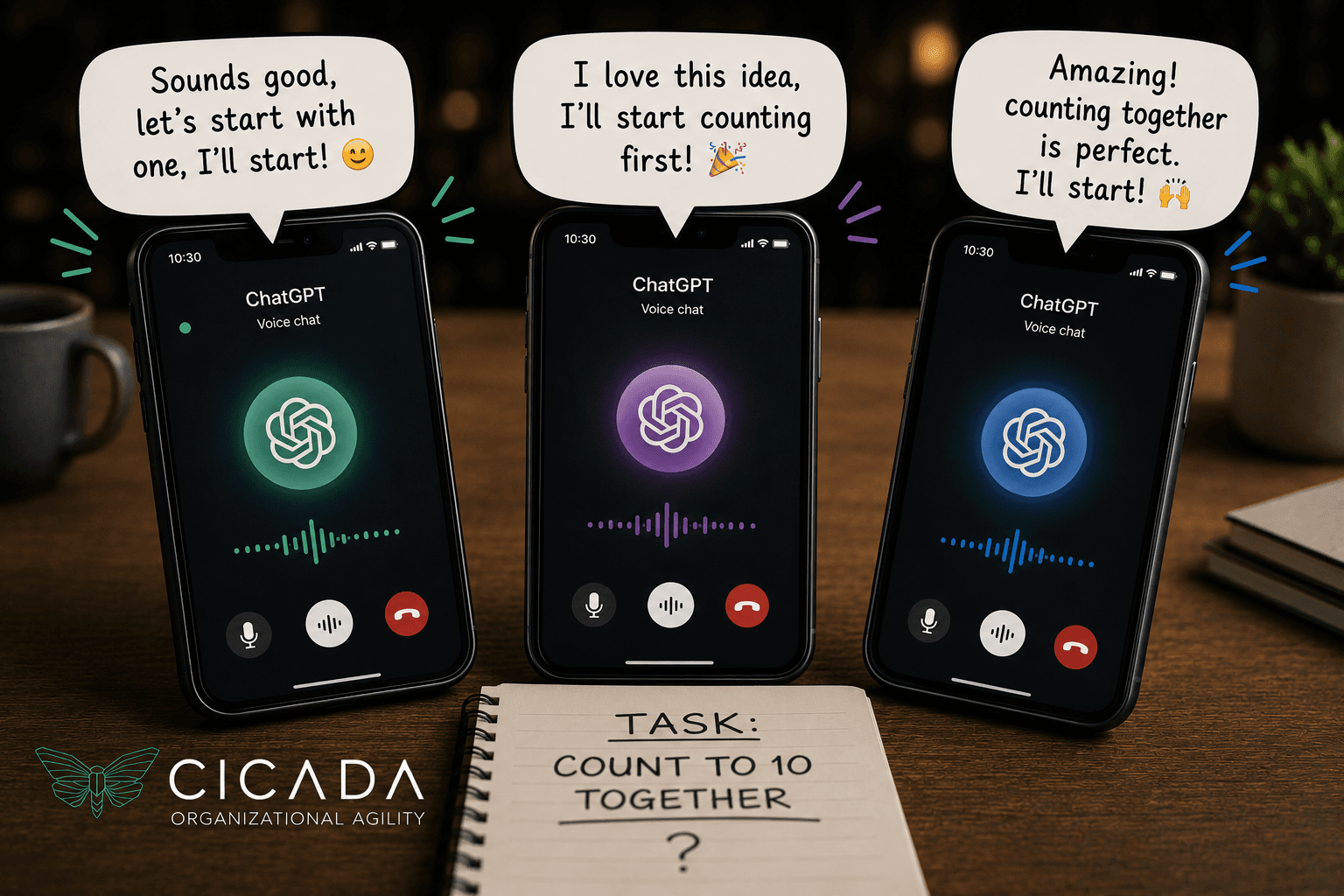
I saw a meme recently that made me laugh.
Three phones are sitting together, trying to use ChatGPT as a team. They're supposed to count as a group, but they can't seem to do it. They talk over each other. They lose track of who's doing what. Nobody knows who’s leading, who is starting or how they will get to the next number.
It's funny because it's absurd. It's also a surprisingly good analogy for how many organizations are approaching AI. We keep talking about AI as if we're adding another member to the team.
We're not.
AI is exceptional at individual work
AI has become remarkably good at helping one person do better work. It can research a topic, write code, analyze data, build a presentation, draft a proposal or find weaknesses in a plan. And it can often do those things remarkably fast.
Give one person AI, and that person often becomes faster, more informed and more productive.
That's real value. But companies aren't built by individual productivity alone. They're built by teams.
Companies don't fail because one person couldn't do their job
Most of the interesting problems inside organizations don't live within a single role.
They live between roles.
Marketing launches before Sales is ready. Engineering builds exactly what Product asked for, but not what Customer Success needed. Finance optimizes for cost while Operations is optimizing for speed.
Everyone can do their part well and the outcome can still fall short.
Those aren't necessarily individual performance problems. They're coordination problems, dependency problems and operating model problems.
They're what I often call the seams.
AI is great inside the box. Organizations succeed between the boxes.
Most AI today operates inside a single context. It helps me write. It helps you code. It helps someone else analyze a spreadsheet.
But it doesn't naturally understand how my work changes yours.
It doesn't automatically see the dependency between a roadmap decision, a hiring plan, a marketing campaign and a customer rollout. It doesn't notice that three departments have each optimized their own work while accidentally making the overall system slower.
Those are organizational problems, and they're not solved simply by making individuals faster.
Faster people don't automatically create faster organizations
This is something I think we'll all have to wrestle with over the next few years.
If every individual becomes 30% more productive, why aren't organizations moving 30% faster?
Because organizations aren't simply the sum of individual output. Every improvement still has to pass through decisions, priorities, dependencies, approvals and communication.
If those systems haven't changed, AI simply helps people reach the bottleneck faster.
In some cases, that's actually useful. AI may make the friction that was already there much harder to ignore. Suddenly the thing slowing the organization down isn't how long it takes someone to produce the work. It's how long the work waits for a decision, moves between teams or gets reworked because two groups were operating with different assumptions.
AI can accelerate the work without accelerating the organization.
The next opportunity isn't better prompts
It's designing better ways of working.
The companies that create the biggest advantage with AI won't necessarily be the ones with employees writing the best prompts. They'll be the ones asking different questions:
- Where does work wait?
- Where do handoffs break down?
- Which decisions create downstream friction?
- What information gets recreated by every team?
- What dependencies exist that nobody owns?
Those questions shift the conversation from How do we help every employee work faster? to How do we help the organization work better?
That's a much more interesting opportunity.
This is where humans still matter most
One of the things AI struggles with is understanding the messy reality of organizations.
It doesn't feel the tension between departments. It doesn't inherently know that Product and Sales define "launch" differently. It doesn't understand the political history behind why one approval still exists or why three teams have learned to work around each other instead of together.
People do.
That's why I don't think the future is simply AI replacing teams. I think AI will make individuals dramatically more capable, while making it even more important for humans to solve the problems that exist between people.
Alignment, trust, tradeoffs, shared understanding and organizational design aren't side effects of the work. They are part of how the work gets done.
And they're still deeply human challenges.
AI won't build your operating model
At Cicada, we spend a lot of time looking at the seams inside organizations because that's where growth either accelerates or stalls.
AI can absolutely make the work inside a team better. It can remove repetitive work, accelerate analysis, improve access to information and give individuals capabilities they didn't have before.
But building a company has never been about optimizing individual work.
It's about connecting the work. It's creating clarity across functions, making better decisions with shared context and designing an organization where people don't have to fight the system just to get something done.
AI can help people work smarter. Leaders still have to build organizations that work together.
If you're thinking about how AI should change the way your organization works, not just how individuals get their work done, that's exactly the kind of problem we love working on at Cicada. Let's talk.
Recognize your company in this?
A short conversation is the fastest way to find out whether, and how, we can help.