AI Transformation
AI Was Everywhere at SF Tech Week. What Does That Mean for Leaders?
SF Tech Week gave us a chance to launch Cicada’s new leadership assessment and sharpen our thinking about what leaders need as businesses grow and AI changes the work. We left with a clearer purpose: helping leaders turn self-awareness into practical growth.
Cicada Agility · October 20, 2026
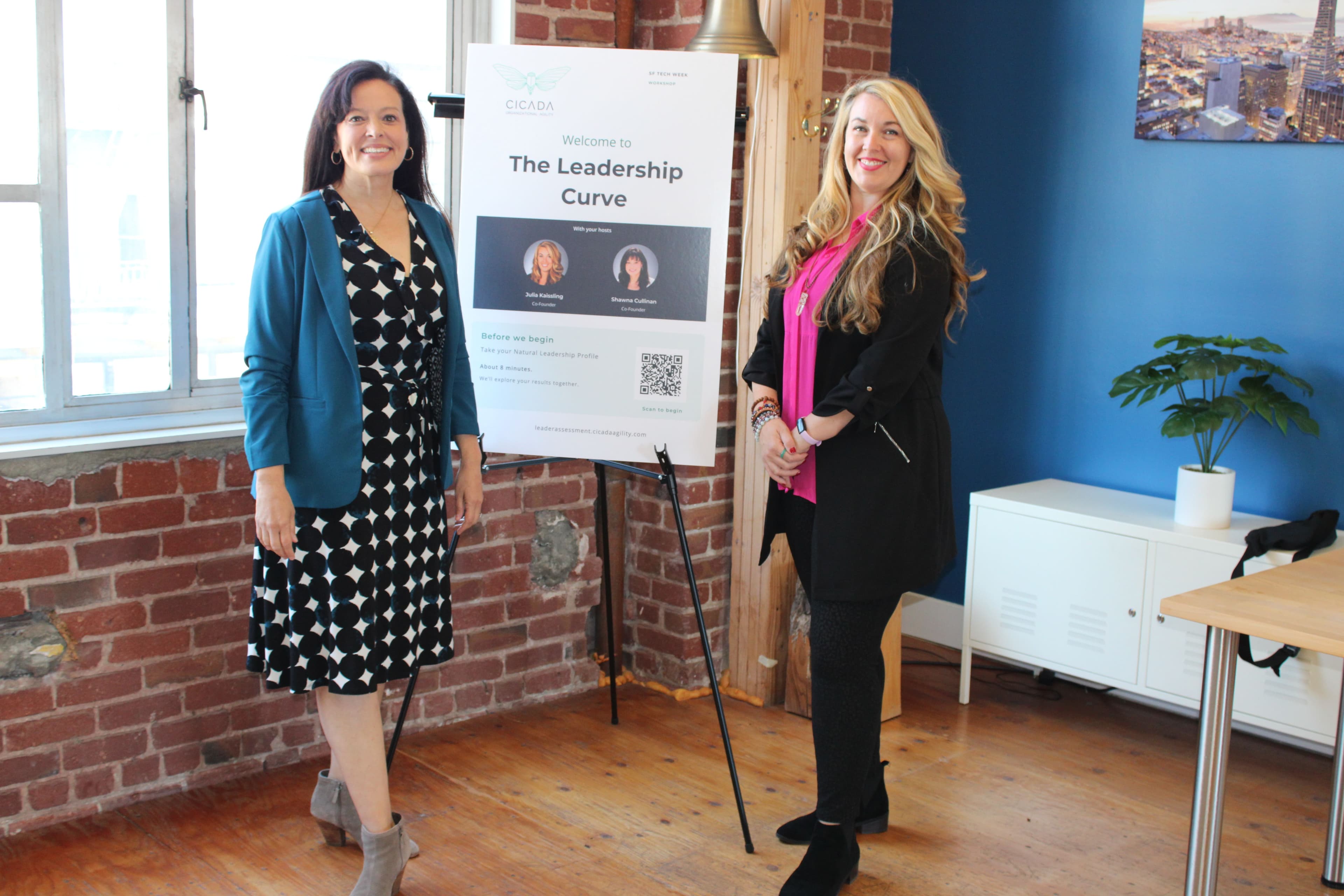
We arrived at SF Tech Week with a question we wanted to explore: What is your company's growth asking of you as a leader?
We’ve spent a lot of time thinking about this question at Cicada Agility. As companies grow, the demands on their leaders change. The approaches that helped a founder build a company from the ground up may not be the same ones needed to lead a growing team, scale operations, or navigate the next phase of growth.
We wanted to explore what happens when a company outgrows the way its leaders have always operated. When does being decisive become a bottleneck? When does a constant stream of new ideas become a distraction? When does staying close to every detail start preventing others from taking ownership?
To help leaders explore that question, we developed the Cicada Natural Leadership Profile, a new assessment designed to uncover the instincts that shape how we naturally lead. We brought it to SF Tech Week to introduce it, hear how leaders connected with the model, and explore how those instincts intersect with the changing needs of a growing company.
That was the conversation we ended up having. But being at SF Tech Week broadened it in ways we hadn't anticipated.
AI was everywhere. From conversations about new products and business models to how organizations are rethinking their teams and ways of working, it was hard to find a discussion that didn't somehow come back to AI. At times, it felt like you needed to talk about AI to be relevant.
It pushed us to rethink our original question. If company growth already requires leaders to evolve, what happens when technology is changing the way companies operate at the same time?
What Is Growth Asking You to Do Differently?
One idea we explored in our workshop was that a company’s stage of growth isn’t defined simply by funding. Two companies at the same funding stage may have very different needs depending on their teams, operating models, and organizational maturity.
As organizations grow, leaders often find themselves needing to do things that don't come naturally. A founder who built a company by making fast decisions may need to step back and let others take ownership. A leader who thrives on exploring possibilities may need to focus more and be more consistent. Someone who has always been the person solving problems may need to shift toward helping others solve them.
The challenge is that we tend to rely most heavily on our natural strengths, especially when things get difficult. Those strengths helped us succeed, so why wouldn't we continue using them?
But what worked when a company had five people may not work when it has fifty. And the very instincts that once helped a company move forward can eventually become the things slowing it down.
Your strengths haven't necessarily changed. But what your company needs from you has.
This is where leadership growth becomes personal. It's not just about understanding what your company needs next. It's about recognizing whether the way you naturally lead is helping your organization get there.
Understanding How We Naturally Lead
We developed the Natural Leadership Profile to help leaders recognize something that can be surprisingly hard to see in ourselves: the instincts we automatically rely on, especially under pressure.
Our model organizes these instincts into four broad families: Vision, Build, Operate, and People. Vision is about seeing possibilities and creating momentum. Build focuses on turning ideas into something real. Operate brings structure, direction, and follow-through. People focuses on creating understanding, connection, and the conditions for others to thrive.
Each brings something valuable to an organization, and each has potential blind spots. A leader who naturally sees possibilities may struggle to narrow the focus. Someone who excels at building may become the person everyone depends on. A leader who drives execution may move faster than others can follow, while someone who prioritizes people and alignment may delay difficult decisions.
None of these instincts are inherently better than the others. And our natural instincts aren't the limits of what we're capable of. They're simply where we tend to start.
The early feedback we received at SF Tech Week was encouraging. People connected with having language to describe their natural leadership tendencies and recognize patterns in themselves. It was exciting to see something we'd been developing resonate with the leaders we hoped it would help.
But for us, that recognition is just the beginning. The real value isn't simply understanding how you naturally lead. It's recognizing when those instincts are serving you, when they may be getting in the way, and when the situation requires something different.
And that's where the conversation about AI became especially relevant.
AI Adds Another Demand on Leadership
Throughout SF Tech Week, we heard conversations about what AI makes possible. New products, faster development, different business models, and new ways of working. The possibilities are exciting, but they also raise questions about what organizations will need from their leaders.
Leaders are being asked to make decisions about technologies they're still learning, rethink how teams work, and experiment without always knowing what success will look like. At the same time, their employees may be wondering how their roles will change, what skills they'll need, and where they fit in an AI-enabled organization.
Leaders’ responses to those challenges are shaped, in part, by their natural instincts.
Someone accustomed to having the answers may need to become more comfortable learning alongside their team. A leader who values control may need to create space for experimentation. Someone who thrives on moving quickly may need to slow down long enough to understand the implications of change for their people and processes.
These aren't entirely new leadership challenges. They're familiar tensions showing up in a new context, often at a faster pace.
And that's what made the AI conversation so relevant to the work we'd come to share. We've been exploring how leadership needs to evolve as companies move through different stages of growth. But AI is introducing another dimension of change, one that doesn't wait for a company to reach its next stage.
Companies aren't just growing. The way they operate is changing around them.
That means leaders need to recognize not only what their organization needs next, but also how their own instincts may influence their ability to navigate what's coming.
What We Learned by Showing Up
Hosting an event during SF Tech Week was an experiment for us, too. With free events and unpredictable attendance, you never really know who will walk through the door. It made planning challenging, but it also forced us to stay flexible and created space to experiment.
We came with a new assessment, ideas about company growth, and questions we wanted to explore with founders and leaders. Putting our work into the world let us hear what resonated and where we could keep developing our thinking.
One of the most encouraging takeaways was how people connected with the language of the Natural Leadership Profile. Giving leaders a way to recognize and describe their instincts created an opportunity for more meaningful reflection about how they show up and where they may need to grow.
The broader experience also challenged us to think more broadly. AI is accelerating changes in how organizations work, making the relationship between company growth and leadership development even more important.
We arrived asking what company growth requires of leaders. We left thinking about a bigger question: How do leaders recognize when the way they've always led no longer meets their organization’s needs, especially in a rapidly changing landscape?
What Does Your Company Need From You Now?
Whether your company is scaling, entering a new market, or figuring out how AI fits into its future, leadership demands will keep evolving.
Think about a challenge your team keeps running into. Maybe decisions aren't moving fast enough, people aren't taking ownership, or there's too much change and not enough follow-through. Now consider how you instinctively respond. Do you take more control, generate another idea, step in to solve the problem, or try to bring everyone into alignment?
Those responses may feel like the obvious way forward because they're what comes naturally. But are they actually what your organization needs?
The next stage of your company's growth may require something from you that doesn't come naturally.
At Cicada Agility, we help founders and leadership teams understand what their organizations need as they grow and how their natural leadership instincts influence their ability to navigate change.
Our Natural Leadership Profile is one way to begin that exploration. It helps leaders recognize their strengths and blind spots, understand how they naturally approach challenges, and become more intentional about where they may need to grow.
We'd love for you to take the assessment, share what resonates, and tell us what it helps you see differently.
Recognize your company in this?
A short conversation is the fastest way to find out whether, and how, we can help.